Kat (Julia Stiles) Is a strong-minded teenager who refuses to conform to societal norms. When her father decrees that her younger sister cannot date unless she does, Kat is thrown back in to the dating world.
Heath Ledger, Joseph Gordon-Levitt, Allison Janney and Larisa Oleynik all co-star in screenwriting team Kirsten Smith and Karen McCullah’s (Legally Blonde, She’s The Man) excellent film.
Despite being based on an arguably misogynist text about “taming” women, this adaptation is upbeat, empowering and down right hilarious. WATCH IT NOW!
Zia (Patrick Fugit) slits his wrists and wakes up in a grey and dreary world for people who commit suicide. When he discovers his ex-girlfriend has also killed herself, he knows he needs to find her.
Adapted from a novella by Israeli writer Etgar Keret by Croatian writer/director Goran Dukic, it definitely has a more multicultural feel than your average American indie.
Tom Waits, John Hawks, Will Arnett, Shannyn Sossamon, Leslie Bibb and Shea Whigham make up the marvellous supporting cast for this remarkable feature.
“You know what’s happened, don’t you?… I’ve fallen in love with you.”
Based on the play by Noel Coward, and directed by David Lean (Lawrence of Arabia, The Bridge Over The River Kwai), this is a quintessentially British romantic drama, set during the Second World War.
Laura Jesson (Celia Johnson) meets Alec Harvey (Trevor Howard) in a railway station, and continues to meet him there week after week. Theirs would be a perfect romance, were they not married to other people.
This film is wonderful. Told in part through Laura’s inner dialogue, the end result is charming, repressed and beautiful.
On the same day that Helen (Gwyneth Paltrow) is fired from her job, she misses the tube by a split second. Her life splits into what could have happened had she caught the train, and what happened because she didn’t.
This is not a comedy. There are funny moments, but ultimately it’s a moving exploration of one woman’s life, and how she is affected by those around her. It’s a philosophical debate marketed as a romance, and it does both.
Starring Audrey Hepburn and William Holden, with cameos from Noel Coward, Tony Curtis and Marlene Dietrich, it plays like a romantic farce.
Gabrielle Simpson (Hepburn) is a typist sent to the hotel room of acclaimed screenwriter Richard Benson (Holden) to type up the pages of his latest masterpiece. The problem is that he hasn’t started writing it yet and only has three days to get it written and delivered to the producer.
George Axelrod (Breakfast At Tiffany’s, The Seven Year Itch, The Manchurian Candidate) penned the screenplay and it was directed by Richard Quine (Sex And The Single Girl, How To Murder Your Wife).
The key to understanding the genius of this film, comes with understanding the changes Hollywood was going through at the time. So here is a brief history of the Classical Hollywood era.
When Hollywood started making films, the rating system that we are all familiar with did not exist. There was censorship or sense of filtering audiences by a film’s content. By the end of the 1920s, Hollywood was getting a reputation as a hotbed of sin and debauchery. Extra-marital affairs were rife and well recorded in the national and international press and there were even a couple of high profile rapes and murders.
In an attempt to restore the at least the appearance of a moral code, the studios hired Presbyterian Elder William Hays who, in 1930, brought out the Motion Picture Production Code (MPPC also known as the Hays Code). The MPPC laid out a series of rule that filmmakers had to abide by, including banning the “use of profanity”, “ridicule of the clergy” and “sex relationships between white and black races”, and cautioning “special care” around “sympathy for criminals”, “men and women in bed together” and “the institution of marriage”. These rules applied to all American filmmaking until 1968 when the Motion Picture Association of America film rating system was put in place, however from the 1950s onwards American filmmakers pushed back against these restrictions.
By the end of 1950s a new style of filmmaking was coming out of Europe, christened French New Wave. Directors such as Jean-Luc Godard, Francois Truffaut and Agnes Varda took a free-form approach to filmmaking, seeing it as a form of artistic expression rather than commercial storytelling. This flew very much in the face of Hollywood’s ethos, which was (and still is) very much the movie “Business”.
This is the period of change that Axelrod was writing in, and that he tapped into when writing this clever little film. His characters write a screenplay that not only jumps from genre to genre but pushes and pulls at the MPPC as well as poking fun at French New Wave.
In a scene within the fictitious film that takes place in the bedroom, Benson comments on the risqué nature of the scene. Miss Simpson responds “You might take that view, but I believe they are playing Parcheesi”, gently prodding the MPPC’s allowances of insinuation. Also within the film within a film, Gaby gets caught up with a French New Wave actor (played by Tony Curtis) who’s involved in a fictitious film about Bastille Day called No Dancing In The Streets because “in this version it, like, rains”.
So watch this film, but when you do, look beyond the farcical romantic comedy and try to see the brilliantly executed satire that lies beneath.
Opening Title: Children believe what we tell them. They have complete faith in us. They believe that a rose plucked from a garden can plunge a family into conflict. They believe that the hands of a human beast will smoke when he slays a victim, and that this will cause the beast shame when a young maiden takes up residence in his home. They believe a thousand other simple things. I ask of you a little of this childlike simplicity, and, to bring us luck, let me speak four truly magic words, childhood’s open sesame: “Once upon a time…”
Between 1899 and 1913 it had been adapted five times, but Cocteau was the first to make a feature out of it.
Josette Day (Les Parents Terribles) and Jean Marais (Orpheus) star as Belle who sacrifices her freedom for that of her father and the Beast who keeps her locked up in his neglected but magical castle.
This film is sublime in ways that I cannot even begin to do justice to in words. It captures the heart of the fairytale; the humour, the romance, the sinister undercurrent and above all the beauty which is so tantalising and keeps us wanting more. Perhaps unsurprisingly based on his work here, cinematographer Henri Alekan went on to be nominated for an Oscar for his work on Roman Holiday (1953).
Initially, writer and director Cocteau and Alekan clashed over the visual aspects of the film. Cocteau favoured a hard-edged style while Alekan preferred soft-focus. As director, Cocteau had the final say and after a rough first couple of days Alekan came around to his way of thinking. The look and feel of the film is heavily influenced by the work of Gustave Doré and his illustrations of the nineteenth century French edition of Don Quixote (see right).
To play the part of the Beast, Marais spent five hours getting into his outfit every morning which included being covered in animal hair and wearing fangs that could not be removed until the end of the days shoot. This meant that he could not eat anything more than mulch during the day to avoid damaging the fangs. Marais had quite strong opinions on what the Beast should look like. Supporting Beaumont’s original story, he felt that the Beast should have a head that resembled a stag, with antlers, to draw upon the image of Cernunnos, the Celtic stag-headed god of the woods. However, as with Alekan, Cocteau’s vision won out and the image of the Beast as he is now recognised in Disney’s version was born.
Beauty and the Beast and Belle et la Bete
I know I have already used the words beautiful and magical to describe this film, but it really is. If you haven’t seen it, you absolutely must! I saw it for the first time at Bath Film Festival and was completely moved.
In case you still had doubts, here is the trailer:
Ethan (Mark Duplass) and Sophie (Elisabeth Moss) seek marriage counselling from a therapist (Ted Danson) who recommends a romantic weekend away to help fix the holes in their relationship.
Debut feature film from director Charlie McDowell (Danson’s stepson) and screenwriter Justin Lader, it was more devised than written. Almost all of the dialogue was improvised around the storyline and for the more complicated scenes Lader would write a few pages as a guide the night before.
Donna (Jenny Slate) is a stand-up comedian coping with a nasty break up when she meets Max (Jack Lacy) and has a one night stand that changes her life and forces her to confront adult life.
Written and directed by Gillian Robespierre, based on her short of the same name, there is a distinct voice running throughout that, while it may not be to everyone’s taste, I cannot wait to hear more from.
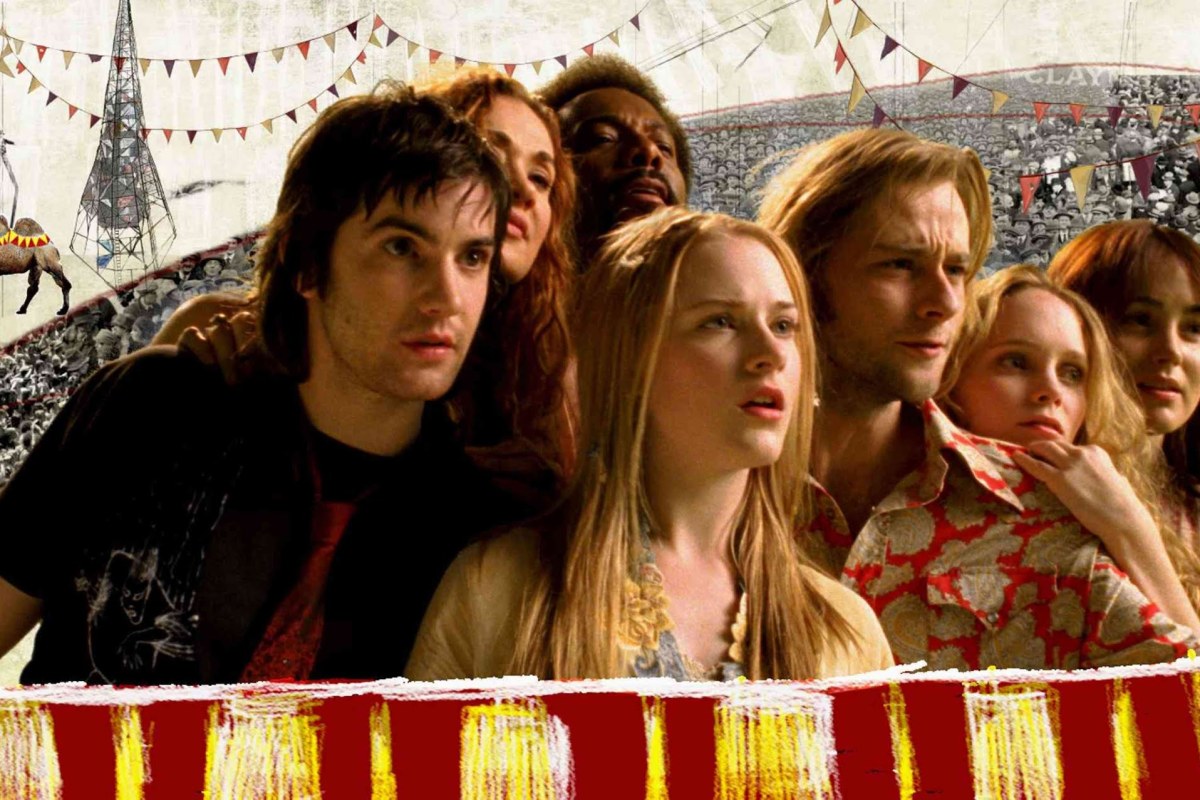
Jude (Jim Sturgess) moves from Liverpool to America where he meets and falls in love with Lucy (Evan Rachel Wood). Set in the 1960s, the socio-political climate of the time makes for a dramatic background to this moving love story.
Director Julie Taymour (Frida, Titus) truly transports her audience. The film’s littered with references to the period, particularly within the music industry, but even if you only pick up the odd one it still makes for mesmerising viewing.
Nina (Juliet Stevenson) and Jamie (Alan Rickman) are in love, completely and utterly. When Jamie dies, Nina expects to be haunted by him, but perhaps not literally.
Written and directed by Oscar winning Anthony Minghella (The English Patient, The Talented Mr Ripley), this is one of those films that will stick with you. Minghella wrote the film specifically for Stevenson and there is no doubt without her and Rickman’s tremendous performances there would not be a film.





 cinemescope